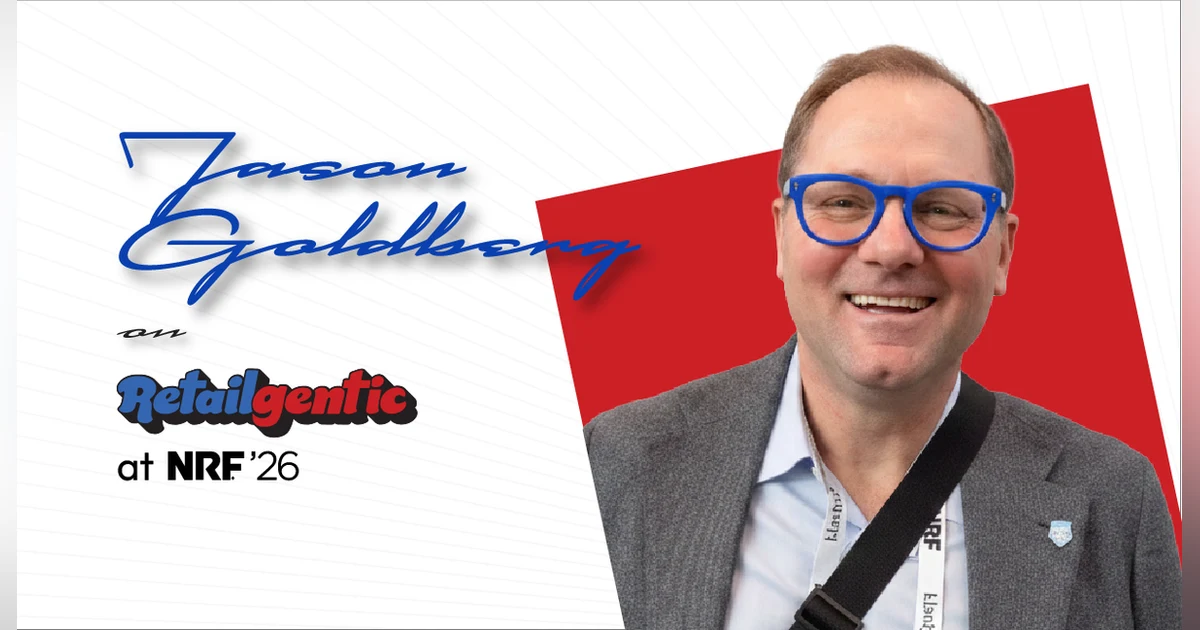
Jason Goldberg's Full Closing NRF 26 Keynote: "Commerce Disrupted: Rise of the AI Native Consumer"


 Overcast
 PocketCasts
 Amazon Music
 Audible
 Youtube Music
 RSS Feed
For this episode we have an experiment for you. The NRF big show concluded Tuesday Jan 13th and Jason was invited to ‘tie the bow’ on the conference in the last keynote:
Commerce Disrupted: Rise of the AI Native Consumer.
For this podcast, we recorded the keynote's audio so you can experience the keynote. If you'd like to see the video we shot as well as the audio it's available here->
https://www.youtube.com/@Retailgentic
The slides are available for you to download in PDF Format here.
0:00 I'm a lot more interested in what I think is a much bigger disruptive change, which are entirely new consumer behaviors because of AI. Um, and so when I'm talking about the disruption, I'm not talking about, uh, being able to make your, your email marketing more efficient. I'm talking about people that discover products and buy them in new ways that they didn't a year ago. Welcome to the Retailgenic Podcast, where we explore the intersection of retail, e-commerce, and AI agents, which we call Retailgenic. Our mission is simple, we are shining a bright light on the new agentic AI shopping mega-trend which will disrupt the trillion dollar digital retail market.
0:47 The stakes are high. Google, OpenAI, Microsoft, Perplexity, Amazon, Apple, Meta, and Anthropic are all fighting to be the consumer AI shopping agent winner. There are gonna be some tough decisions for online brands and retailers to make. What happens to checkout? How should payments work? Should you continue to invest in retail media networks? What does the world look like when over half of your traffic is not from humans, but from AI agents? These existential questions are the tip of the iceberg. On this podcast, we're talking to industry experts, analysts, and influencers to get answers to these questions, identify trends and best practices.
1:31 Uh, this is Retailgenic, your podcast partner in navigating our AI shopping agent future. And now here's your host, Scott Wingoooo! Welcome to the Retailgenic podcast. Today, we have something different, but hopefully fun for you. As you know, the NRF Big Show 2026 just wrapped up earlier this week on Tuesday. The last keynote of the entire conference was my good friend and podcast partner, Jason Goldberg, AKA Retail Geek.
2:15 Uh, last year, Jason and I celebrated 10 years of podcasting together, and it's been a wonderful partnership. Each episode, I learn a ton from Jason about some nuance about, um, consumers, retail, digital tags, payments. He knows a million things about a bazillion things. That being said, as I was watching this keynote and reflecting back on those last 10 years, I came to the conclusion that what I've really learned the most from Jason is how to be a better storyteller. That's Jason's superpower. He is a great storyteller of retail stories specifically, which obviously is great for what he does, and this keynote is a really good example of that.
2:56 He's so good at this superpower that he is always jetting around the world delivering keynotes at digital retail events, uh, and with Publicis top clients. He always mentions Walmart, but they have many others. The title of this keynote is Commerce Disrupted: Rise of the AI-Native Consumer, which is also near and dear to my heart. So for this episode, we did an experiment, and what we're trying to do is put you in the audience. Maybe you couldn't make it to the keynote, maybe you've never been to an NRF before. So what we wanted you to do is feel like you were there. If you watch the video, you'll get the full immersive experience. Uh, you can see the size of the room, the A/V setup, uh, how Jason moves around the stage, how he gesticulates, all those good things if you're really into this speaking, storytelling thing like, like I am.
3:45 Um, if you're on the audio, that's great as well. Um, the, the presentation is definitely worth looking at while you go through this or afterwards. We are including that on the Retailgenic Substack. I'll also post that on LinkedIn for you. Um, I hope you enjoy this as much as I did. It's a really good story, uh, and it raises some interesting questions about what's gonna happen with agentic commerce and the future. And now, without further delay, Jason Goldberg, Retail Disrupted: The Rise of the AI-Native Consumer.
4:29 Oh, Bet you think that she is so cool. couch Oh my god. Retail is the greatest industry in the world, and I am in front of the best-looking, smartest, most diligent people in all of retail. It's the very end of the show, and you guys are still here, hungry for more content. This is amazing. Or, my podcast co-host, Scott, hired a bunch of seat fillers. Uh, so give yourself a hand for still being here and still learning at the end of the show. Come on, guys, you totally deserve it. Yeah, and if you could indulge me for one extra second, did everyone have an amazing show?
5:11 Yeah? Yeah? Like, we had lots of good conversations and learned a lot? Uh, that is because the NRF staff has been working crazy for months to get ready for this show, and they've been working nonstop since they've been here. So if you could do me one favor and give a hand for Matt, and Jill, and Paul, and Eric, and all the folks that have been working hard to make this a good show for us. Thank you, guys, very much. Yeah. Uh, so I'm gonna jump right into it. We're gonna be talking about the disruption of AI, so no, no spoilers there. Uh, and in the highly unlikely event that anyone in this room doesn't get enough of me in the next 4 hours, I think I have.
5:52 4 hours, uh, I have great news. Uh, I have a much smarter friend, Scott Wingo. He and I accidentally started a podcast at this show l- like, over 10 years ago before podcasting was cool, and there are now, like, 400 hours of us on the interweb talking about this stuff. So, so y- uh, Scott's parents very helpfully spelled his name wrong with only one T, uh, so it's super easy to find, uh, in the search engines. And you're, you're welcome to tune in and join us for this discussion. Um, but as I said, we're gonna be talking about this giant thing we're living through right now, agentic commerce disruption. And this is gonna be a participatory session. You guys are gonna have to help me.
6:33 We're gonna answer a couple of big questions that have been on everyone's mind, uh, while we're here. So, we're gonna- we're gonna get an amazing outcome, but I have to kind of set the table. So, one of the big questions is, how big a deal is agentic commerce, right? And so I wanted to kind of very quickly share 2 perspectives. Uh, if you were here on Sunday, uh, you saw Sundar on stage, and he, he famously is very bullish on AI, not surprisingly. You know, he's like, "I don't know, maybe as big as electricity or fire." Um, and the, the former, uh, uh or one of uh, at Amazon, they also, of course, are very bullish on this.
7:13 You know, th- this is probably the biggest innovation since the invention of the internet, which was quite relevant to most of us in this room. Um, and somewhat humorously, another great, uh, technologist, Bill Gates, said, "Yeah, it's gonna be so big that you're probably not gonna go back to Amazon again when it happens," which I'm not sure Andy appreciated that quote. Um, but so there's a lot of luminaries in our industry that think that this is a huge, transformative deal that we all have to immediately get ready for. But not everyone agrees with them. Uh, if you hang out in the weird corners of LinkedIn that I hang out in, uh, there's a bunch of smart people that are dubious, right? So, I have a good friend, Andrew Lipson.
7:54 He's, he's a great analyst. He's one of the, the pioneers in writing about retail media, uh, and he's a great voice in our industry. Uh, a couple months ago, he wrote an article called, "Agentic commerce is one giant hallucination." No one's ever buying anything from the robot. No one's ever gonna trust the robot, right? Um, and another dear friend of mine, Sucharita, uh, Kudai, from, from Forrester, uh, she had a slightly more balanced take, but she's like, "Hey, it might be a thing, but it's a small thing." Like, less than 2% of, of, uh, all the questions on, on, uh, ChatGPT, for example, are related to commerce. Um, so she thinks it's overblown, right?
8:34 Uh, so one of the first things I wanna do is gauge the audience before we get going too far in how big a deal you think it is. So, we're gonna do a survey. Now, I wanna quickly warm everyone up for the survey. Uh, get out your phone. If you're playing Angry Birds, I'm sorry, you got to abandon your map. Um, and scan this QR code. This is the practice session before, before we jump into the actual survey. Scan this QR code right here. And it's gonna take you to a survey, and the correct answer to this survey is, "Five stars, he was amazing." So, if everyone could just fill out, "Five stars, he was amazing." You can paraphrase if you choose.
9:15 Um, that, that would be awesome. Uh, and so now that you're all warmed up, now that y'all have your phones out, now that you all know how to scan a QR code, we're gonna go to the Slido survey, which is, "How big a deal is agentic commerce?" Is it Andrew Lipson, total hallucination? Is it Sucharita, real but overhyped? Is it, uh, sort of somewhere in between? Uh, it's the latest in a long line of disruptions, like social and mobile? Um, or is it the, the most important thing that's, that's ever happened to us, right? Um, yeah. And so you can see there's some, some controversy in the room.
9:57 Like, there's, there's very few Andrew Lipsons, but the other 3 are pretty close. It's pretty, pretty neck and neck, which is interesting. Um, I'm gonna share some facts with you, and then we're gonna see if you still feel the same at the end. Uh, but I do have one more question. If it is a big deal, if it does become a meaningful part of commerce, the next magic question is, who's gonna win? Is it the giant incumbents with the huge booths that you've seen downstairs that have already been winning that are gonna have an intrinsic advantage? Or, is it all the cool new innovative companies in the startup pavilion?
10:38 Uh, Scott has said on our podcast a few times that if your company was born before agentic commerce was invented, you're probably not gonna win at, uh, agentic commerce. So, so he would certainly be betting on the new challengers. Uh, but there's some reason to believe that there's some, some resource advantages, uh, for the incumbents. So, it seems like we're split about 60/40 in that room. Okay. So, one more thing I have to do before we get into it. I intentionally asked you those questions without defining agentic commerce. Um, but I really think definitions are important. I think it's kind of boring and geeky to talk about definitions, but I find when a lot of us are debating these things, we're using the same words, but we have wildly different meanings.
11:25 So, I just wanna kind of ground everyone for the purposes of this presentation. Um, and if you haven't noticed, every single exhibitor at NRF is an AI company. It's in every single company's name. And, like, in the 4 words they had to dedicate to the sign on their booth, 3 of them were AI, I'm pretty sure. Uh, I, I bought a hot dog from the AI hot dog vendor on the booth today. Um, and that's potentially true, because AI is incredibly broad. It's a tool that can impact almost anything, right?
12:08 And so, there's a ton of things retailers have been doing since the beginning of time that AI can absolutely make more efficient, that AI can make better, right? And so, I, I call that whole genre of AI the efficiencies genre. And if you wanna make money today with AI, that's probably where you should play. Like, there's lots of improvements to supply chain, and staffing, um, and order management, and, uh, uh, product merchandising, uh, that efficiencies can dramatically help. So, I'm not trying to pooh-pooh efficiencies. I'm just trying to say that's not what I'm talking about. I'm a lot more interested in what I think is a much bigger disruptive change, which are entirely new consumer behaviors because of AI.
13:05 I'm talking about people that discover products and buy them in new ways that they didn't a year ago. Uh, so that's, that's my definition of agentic commerce. And then, I have to address one other part of this. And this is a huge debate, uh, on, on LinkedIn right now. Um, as soon as you start arguing with someone about how big agentic commerce is, one of the first questions that comes up is, "Well, are you talking about how many times the robot takes the credit card? Or are you talking about how many times the robot influences a purchase decision," right? And we've been arguing about this since the beginning of e-commerce. Like, is, is e-commerce only the orders I take on my website?
13:49 Or is it all of those sales that get generated after you use Google Maps, and read ratings and reviews, and do all this digital product research, and then you walk into a Target and buy the product? And then as social commerce came up, we had those arguments again. Is social commerce just TikTok Shop? Or is it all the products that did, get discovered on TikTok? And we're having that same argument again. Is agentic commerce all the orders that the robot takes and collects the money for? Or, is it all of the new purchases that wouldn't have happened had it not been for the robot, right?
14:35 Agentic commerce is new customer behaviors, not the efficiencies, and it's the whole pool of new purchase behaviors that get influenced as a result, right? So, you remember that first question I asked is, "Who wins? Incumbents or challengers?" And I have some bad news for you. Historically, this level of disruption is not awesome for incumbents, right? Yeah, probably not. I wanna tell you, uh, what I think is a more illustrative story. I wanna tell you about, uh, one of my marketing heroes, uh, this gentleman, Frederic Tudor. And I, I wouldn't expect too many of you to be familiar with him.
15:25 And he had a new business venture in mind. He's much like Scott. He's just serial entrepreneur. Um, so, so Frederic Tudor grew up on a farm in, uh, New England, I wanna say, the Tudor Pond. It was a pond in the backyard of his, his family's farm. And he had this idea that there are all these new rich expats living in the Caribbean, and he imagined that they would really enjoy a cold beverage if only there was cold in the Caribbean, which in 1800, there was not. So, he had a revolutionary idea. "I'm gonna carve out the ice from my family farm. I'm gonna put it on a boat and ship it to the Bahamas."And just you know, about half the ice melts on the way from New England, uh, to the Bahamas.
16:36 By about 1840, Frederic Tudor was w- worth $200 1000000, which is billions of dollars in today's currency. And it spawned a whole industry, ice harvesters. A ton of it got harvested right here in New York, uh, and it was the largest industry in the world. The Norwegians are apparently are very good at ice. Anyone buy any Tudor Ice?
17:18 Because what Tudor and none of his competitors foresaw is the invention of artificial ice. Artificial ice is ice made in a factory, all right? And the American Ice Company started making ice in bulk, and it could make ice in the Bahamas so you didn't have to put it in the boat, you didn't have to mail it, uh, uh, uh, sail it to, to India. It was much more efficient. And the American Ice Company completely put Tudor Ice out of business. Uh, by, by, uh, 1914, 85% of the homes in America got regular ice deliveries. You had a cooler, an ice man came to your house, put ice in it, and that's how you kept things cold.
18:02 Y'all familiar with the American Ice Company? Yeah, you know why? And so here's the lesson. None of the ice harvesters, the largest company in the worl- uh, industry in the world became ice factories, and none of the ice factories became ice, home ice makers. And I'm gonna predict the future for you. I'm gonna tell you what the next big innovation in ice is. It's, it's the nugget ice. Uh, if you, uh, ever went to Sonic, they had this delicious, chewy, aerated ice, and people literally drive through Sonic, don't get a hamburger, but just buy bags of ice.
18:55 And so magic question for you, are all those home ice makers gonna be the ones to invent the nugget ice machines, right? If you don't know, you deserve an incredible amount of credit. Last year in the United States of America, we sold $5.3 trillion worth of stuff. That's a lot of stuff, right? Um, that's about 3 1/2%, 3.6% growth. We grow between 3.5 and 4% a year for the last 10 years, so 3.6 is right in the, the sweet spot of that.
19:40 Um, so we're, it was kind of an average year. I don't like talking about averages. Do you know why? On average, the country of Nepal is flat. There are exactly 25,000 feet up and 25,000 feet down. So if you talk about averages, you would miss the giant mountain in the middle of, of, uh, uh, Nepal called Everest, which is pretty important, right? So in the same way that 3.6% growth, that's $183 billion of stuff you guys sold that we didn't sell the year before. And that's amazing. Like, you don't get enough credit. But when you say, "Who got all those sales?
20:21 Was it incumbents or challengers?" the story gets very different, right? Uh, this is not e-commerce. This is retail. Amazon got 31% of all that growth. Walmart got the next 14% of all that growth. The next company is my nemesis, Costco. Do you know, uh, hopefully, Costco's not in the room. Uh, I should have asked. Uh, do you know why Costco is my nemesis? They are famously the retailer that most often does not take any of my advice and is wildly successful for doing so. So I'm, I'm a little bitter. Uh, but they, they alone represented 7% of all that growth.
21:01 So 3 incumbents represented half of all the growth. The next biggest chunk is 3 challengers, 3 companies over the last 3 years that invented direct to consumer models from China. So if you don't know, 3 years ago, Shein became the fastest growing retailer in the history of mankind. They didn't get to keep that title very long because the next year, Temu launched a Super Bowl ad, and in one year, surpassed Shein in sales. Uh, and if that wasn't impressive enough, last year, TikTok Shop sold $9 billion in their first year of business. Um, so these 3 companies that we don't talk about enough here, uh, have, have revolutionized their industries and become some of the fastest growing companies.
21:45 So we've got incumbents winning half the growth. We've got challengers winning a big chunk of the growth. And what that means is every other NRF member had to fight for 38% of that growth, right? So when you disaggregate this, it becomes an interesting story. There's some incumbents that win, there's some challengers that win. It's the, uh, excuse me, the uncomfortable middle where you don't wanna be. So, so how is th- What is this disruption? How is this disruption? Uh, I like to call it the disruption of discovery. Uh, I've been doing this a while. I've been in the business for over 30 years. And for my entire life, the greatest source of leads in the history of retail is our beloved SIS, saw in store.
22:36 I went to the store, uh, to get Oreos for my, my 10-year-old's lunch, and he discovered the Coca-Cola-flavored Oreos and made us get them, which sidenote, is not my cup of tea. I don't know if you've tried the Coke-flavored Oreos. Um, but the, uh, that discovered it in the store and decide to buy it is how retail has always worked. And our friends at Procter & Gamble literally invented a name for it. They call it the first moment of truth, and we invented a marketing discipline around it. We call it shopper marketing, and many of us in this room are the absolute black belt world champions in, in shopper marketing. Saw in store is how we launch new products. It's how we invent new flavor profiles.
23:18 Uh, it's the most important marketing vehicle we have. Only one problem. It's being disrupted, right? Some of you that know me know that I have an unhealthy relationship with caffeine. I don't know if there were any, any clues about that when I came out on stage today. Um, but if you're in my hometown, you, you would probably have some other evidence at any of the Starbucks in Chicago where I'm the customer of the month at all of them. Um, and if you had a chance to visit my refrigerator right before NRF, you might, you might see a familiar logo. So imagine the saw in store experience for Jason "Retail Geek" Goldberg buying coffee, right?
24:00 I go into the Target. I have to walk by 38 other brands of coffee, all that have a chance to conquest me, to tell me about their new flavor fro- flavor profiles, to get me to try that Dunkin'. And if none of them succeed, I get to my beloved Starbucks section, and Starbucks gets to tell me all about their new flavor profiles. They get to expand my wallet. That is shopper marketing. Does anyone in this room believe that that's how I got coffee? How am I gonna get coffee? I'm gonna go to Target.
24:43 And nobody got a chance for serendipitous discovery. Nobody got a chance to introduce new flavor profiles unless you bought some retail media from Andrew Lipson, right? Few retail media spots, but I missed all that chance for serendipitous discovery. And I have a secret for you. This isn't how people discover coffee anymore either. Do you know how people discover coffee today? The TikTok, right? A dude took this thing that we've all forgotten existed called instant coffee. Does anyone remember instant coffee? He puts it in a cup, sugar, hot water, emulsify it, pour it over ice. It's a delicious caramelly, creamy sh- uh, caffeine delivery vehicle that he called whipped coffee.
25:28 A bunch of other talented creators made better versions that were s- seen tens of millions of times. And that week, I got a panicked call from one of my clients, Walmart. "Hey, Jason, we are sold out of instant coffee nationwide, and we have no idea why." Right? And think about it. Walmart has the greatest supply chain in the history of mankind. They're amazing at inventory. Can Walmart restock 4,700 stores with instant coffee in a week? No way, right?And did this trend last longer than a week? Did any of you have whipped coffee this morning? No. So by the time, uh, they were able to restock, this trend had come and gone.
26:11 And that would be a tragedy. But the bigger tragedy is I've gotten a call like that from a retailer every week for the last two and a half years. Last month, it was my friends at Sam's Club. Uh, an influencer went viral with their amazing, uh, flavored artificial crab legs, and I literally got a call, "Hey, we can't get any more artificial crab legs. Do you think we could sell real crab legs and call them imitation crab legs?" Which I, I don't think they were being serious, but they didn't do that. Um, so these disruptions of, of social media being where people discover product on is a huge deal.
26:59 Yeah, unless you're in the sunscreen industry, there's no way, right? And if I opened all those sunscreens and squirted it into your hand, could you tell a good one from a bad one? So how do we all pick sunscreen? I already told you the answer. The TikTok, right? South Korean sunscreens. Um, when I first met him, he had 20,000 followers on TikTok.
27:39 Today, he's got four million followers, and he did a Super Bowl ad. Um, so this is how people are discovering products. But increasingly, they're using a new tool. They're going to the robot. "Hey, ChatGPT, what's the best sunscreen to buy for my 9yearold son to go on vacation to Hawaii?" Slight humble brag there. Does anyone get why I'm thinking about sunscreen now? Yeah. The robot didn't get the 3 words I typed into Google. It gets 26 words on average. And the robot doesn't answer just based on those 26 words. It answers based on every question I've ever asked the robot.
28:28 Only I'm tricking you. That's ChatGPT. Do you know what the results were 2 months ago? They looked a lot more like an e-commerce site. They had product tiles, and I could click through and buy the product. If you did this search over Christmas, this is what it would look like. "Don't go to a retailer. Just buy the sunscreen straight from us. We're selling Glossier direct," right? And see what you want, click on it. Uh, 3 clicks, that'll be relevant later. Uh, check out, and bam, you've got sunscreen at home. And think about how much of this has happened in the last quarter.
29:08 Think about how much of this has happened this week, right? Uh, ChatGPT launched a dedicated shopping research engine, uh, right before Thanksgiving. Um, and then on Thanksgiving, Target launched an app that you could use to do research for sunscreen and buy sunscreen direct from Target on ChatGPT. Uh, Perplexity, which had been doing this for a year, launched a new version of their checkout that allowed you to be the merchant of record on Perplexity the day after Target launched its app. Uh, by the end of Cyber Week, Walmart had announced that they were gonna make available their entire product catalog on ChatGBT, GPT. Um, last week, on Monday, Microsoft announced that if you find products you want in Copilot, you can buy them direct from Copilot.
29:54 And on this very stage on Sunday, Google announced that you could do it from Google, right? So think about what that means. Agentic commerce is, "Hey, Siri, never let me run out of ingredients for my kid's lunch again." And think about what Siri's gonna do. She's gonna go, "Oh, Jason's kid goes to Chicago Public Schools, and here's the lunch schedule. And Jason flies too much on United Airlines, and I see he's got a vacation booked for Hawaii, he's not gonna need lunch that week.
30:37 And Jason buys all his groceries at Walmart. Even though he doesn't live near a Walmart, he's pandering to his customer, so he buys all his groceries at Walmart. Um, and I see from his Walmart purchases that Jason's kid doesn't eat peanut butter. Jason's kid only eats Pirate's Booty, and so I'm gonna make sure that Jason never runs out of Pirate's Booty." Right? That is agentic commerce. And do you know what's scary about it? When I first started, I launched my first e-commerce site at Blockbuster Entertainment in 1993, and it took 22 clicks to buy one of the 8 Disney movies you could buy in the world in, in 1993. Um, I'm still waiting for my residuals from that, that gig. Um, I spent my entire career getting 22 clicks down to the 4 clicks I mentioned earlier, and honestly, I thought that's what was gonna be on my tombstone, "Here lies Jason 'Retail Geek' Goldberg.
31:27 He got us down to 4 clicks. High 5." Right? And I would've been totally satisfied, until the bastards invented one click. Do you know why I'm bitter about one click? Do you know how many clicks it takes to make a one-click purchase? It takes 4 clicks. They just marketed it better. I'm so mad that I didn't think of that. But the robot that we just met could buy our products with 0 clicks, right? And so all of that friction, all of that marketing, all of that persona work that we're doing to sell to the Goldbergs goes away when the NVIDIA microchip makes sure I never run out of Pirate's Booty. And the guy that invented the word for this, agentic commerce, is a super credible AI scientist, he's Professor Andrew Ng, professor at Stanford.
32:15 Ran Google's Deep Think AI Lab, People Magazine's Most Fascinating Man in the world in 2013 for his AI research. Totally legit. Invented the phrase "agentic." Uh, if you're curious what Dr. Ng is doing today, meet the newest mor- board member at Amazon. So if you're wondering what Amazon thinks the future of commerce is, you can bet that they're thinking about agentic commerce, right? And it's already happening.
33:03 And on Black Friday, 38% of all Amazon sessions used Rufus. So for the first time this holiday season, a bunch of our shoppers met an agentic agent, but that agent lived on a retail website. You had to already know you needed something from Amazon or Walmart before you met that agent. And potentially, that's not gonna be the future. Potentially, you're gonna use a robot that's gonna pick the retailer for you, right? So if you go to chatgpt.com or copilot.com or, uh, gemini.google.com or perplexity.com, you can get all this amazing research, you can get products recommend- recommended, you can even buy products and you never had to pick a retailer.
33:49 You never had to go to Amazon. You never had to go to Walmart. So the, the onsite agents may well lose, uh, some or all of the traffic to the offsite agents. And by the way, this isn't just happening on the web, this is happening in the store. I took the ChatGPT app to my local Kroger store, and I pointed it at the sunscreen aisle and I did this, "Hey, ChatGPT, what do you see?" I see a variety of lotions and sunscreens. I'm going on vacation to Hawaii with my 9yearold son.
34:33 Look for mineral-based options with zinc oxide or titanium dioxide. Brands like Blue Lizard or Badger are good. Make sure it's at least SPF 30 for both you and your son. Do you see a suitable choice on the shelf? Also, the Alba Botanica ones to the right are another good choice. Both brands offer mineral-based broad-spectrum protection. Great. Which one would you recommend I try? Sun Bum is a popular choice and easy to apply, especially for kids. It's reef-safe and provides broad-spectrum SPF 50. I'd give that one a try. Perfect. Thanks very much.
35:14 You're welcome. Have a fantastic trip to Hawaii. Thanks, ChatGPT, I will. She is super friendly, by the way. Um, so it's happening in-store, but all of these websites and stores that are hoping to win agentic commerce, they may lose to something even more upstream. They may lose to the browsers, because the, the AI companies now make their own browsers, like Comet and Atlas, and all the legacy browsers are building robots into the legacy browsers like Edge and Google Chrome. Um, and so-It may be that we don't even go to a website to go shopping. We're, we're always shopping the robot whenever we're in our website.
35:58 Maybe the robot's just built into your phone and your operating system does the answer before you ever do any of this, right? And that's what the, the Apple Google announcement was yesterday, is that the robot's built into Apple devices, it's built into Go- Google devices, it's built into Microsoft devices. And so, uh, we may ubiquitously have the robot. OpenAI bought Johnny AI's company for $4 billion to build the robot into all of our brains very likely, right? And this isn't the future. This is already happening. Uh, ChatGPT released all of their data from last July and they gave it to a bunch of Harvard researchers that published a study. It's the study Sucharita referenced in her thing.
36:39 And in that study, they said only 1.9% of all our prompts are trying to buy something. But just so you know, that's 1.9% of 12 billion prompts a day. So I did some public math for you. That's 52 million prompts a day people are trying to buy something off of ChatGBT last July. And just so you know, you couldn't buy anything on ChatGBT last July. It was a research engine only, but it was already getting 52 million visits a year and they're doubling every 6 months. So this is probably over 100 1000000, uh, questions that they're getting today. But even if it's still 52 1000000, just so you know, that makes ChatGBT the 9th largest e-commerce site in the world.
37:27 They're, they're a top 10 e-commerce site in the world without commerce, just based on 1.9% of their prompts being commerce related. And I know most of us do business in the US so I extrapolated that to the US. It's about seven billion prompts, uh, seven million prompts a day in the US, which makes them the 11th largest e-commerce site in the US. Bigger than Home Depot or Best Buy already, and it's getting much bigger. Um, so I'm always interested in proof points. Uh, I found this, this, uh, great company, uh, called Measured Protocol. They have a panel of users that actually give them their ChatGBT logs. So this isn't a survey.
38:20 So a huge amount. And we know from all of the, the, the robot analytics company, this is from my, my, uh, friends at Evertune, um, that each robot has different criteria and is giving us different answers. And we're not doing the same on all the robots. And the robots aren't giving the same answers that the search engines gave. So the robots for salty snacks care a lot about, uh, ingredients and healthfulness, um, and, uh, some of the most popular salty snacks don't do well, uh, for those criteria. And when you go, "Wait, how did the robot decide what was important?"
39:01 The robot is reading tons of micro-influencers' blogs to learn what, what's important. They're reading Reddit to learn what's important. They're not reading our manufacturers' websites. They're not reading our retailers' websites near as much. So if we're gonna win the robots, we have to understand what's important to the robots, which is going to change every day. So we need tools and we need business processes to understand what the robots care about, right? They're still arguing, but they call it GEO, generative engine opti- optimization, or AEO, answer engine optimization. Uh, and my, my friend Scott has, has proposed that, hey, those are important, but what you actually need is something more strategic.
39:43 You actually need, um, uh, agentic commerce optimization. You have to optimize for your product catalog. You have to optimize for the business outcomes. You have to optimize for the customer expectations. And so you actually have this bigger job of which GEO is a small part, and he, he started a company here at the show, Refibuy, to try to help brands with that, right? And so I want to leave you with one last piece of advice I got from a much smarter person. Uh, as you may have heard, the CEO of Walmart is retiring this month. Uh, I'm super bitter because he's not shy to point out that he's 2 years younger than me and he's retiring, so just saying.
40:26 Uh, so for the last 2 years, every meeting that Doug McMillon's gone to at Walmart, do you know how he starts the meeting? "Hey, y'all. Thanks very much for coming to this meeting. I appreciate all your, your time and attention. Before we get started, how did you use AI to prepare for this meeting?" And I asked him once, I said, "Why, why are you always asking that question?" And he said, "Well, it's simple. Like, I'm not the fishing merchant anymore. They won't let me pick any products. And John Furner won't let me muck with the USPNL anymore. He owns that, right? Uh, and so my job is to be the change agent. The hardest thing in these disruptions, Jason, is not the technology. It's not the strategy. It's getting the 1.6 million Walmart associates to think different.
41:10 It's the organizational change management, and I'm the head cheerleader for thinking different. So I'm gonna keep asking and making people think different about these new things." And do you know what the answer was in that first meeting, the first time he asked the question, "How, how'd you use AI to prepare for the meeting?" It was a bunch of crickets looking at him, and then some brave soul looked at him and said, "Doug, it's illegal to use AI at Walmart. Like, it's been banned." Uh, and so think about what's happened over the last 2 years. They've gone from IT locking down all the AI tools to buying AI tools for all 1.6 million associates, to creating 6 of their own super agents. Uh, Sparky and Marty and @Walmart, and the, the Walmart developer, uh, agent.
41:51 And so what I, I wanna leave you with this final thought is, while the tech is important, the strategy is important, we have to think about how we're gonna take all those human beings, all those coworkers in our organization, and get them comfortable with this disruption so that we don't end up being the Frederic Tudor ice harvesters or the American Ice ice factories. And I know you're all on pins and needles, so I'll leave you with one final fact. My family did in fact make it to Hawaii. So thank you guys very much for your attention. Congratulations on an amazing show. Follow, rate, and share to stay up to date with Retailgenic, your guide to the future of AI shopping agents.