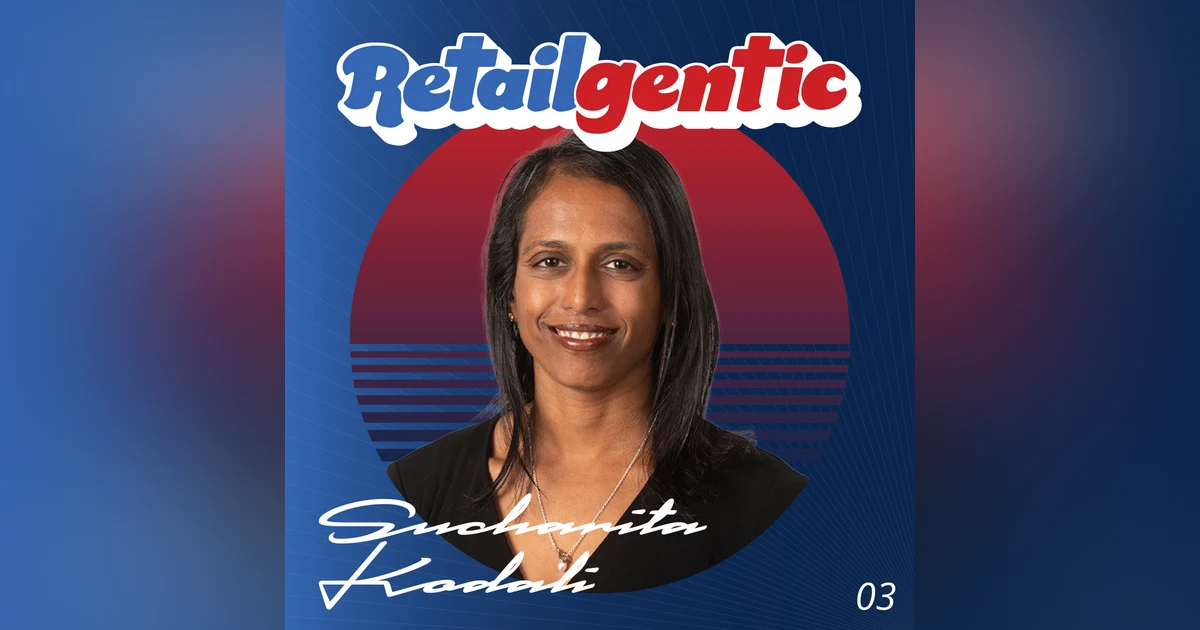
Retailgentic crossover: Sucharita Kodali - VP and Principal Analyst, Forrester Research


 Overcast
 PocketCasts
 Amazon Music
 Audible
 Youtube Music
 RSS Feed
In this episode, Scot Wingo is joined by Forrester retail analyst Sucharita Kodali to dive into the emerging world of agentic shopping and the growing influence of generative AI in commerce. They cover:
- The explosion of retail media networks
- Why marketplaces are making a comeback
- OpenAI’s retail ambitions (and that Instacart CEO hire)
- GenAI adoption across retail use cases
- The rising threat to Google from TikTok and AI search
- What’s actually agentic vs. “faugentic”
⏱ Notable Timestamps:
00:06 – What is Retailgenic and what’s at stake in AI shopping
03:00 – Why retail media networks exploded post-COVID
07:30 – Instacart’s ad business & the OpenAI CEO move
10:00 – How big retailers are actually using GenAI today
14:00 – Is Google search under threat from ChatGPT, TikTok & Perplexity?
20:00 – Agentic shopping: hype vs. reality
26:00 – Could AI replace ticket brokers and influence high-demand shopping?
31:00 – The power of TikTok shopping and influencer-led discovery
33:00 – Closing thoughts on what’s truly “agentic” vs. faugentic
👉 Subscribe for more deep dives into the AI commerce revolution: https://www.retailgentic.com
📺 Watch episodes on YouTube: youtube.com/@retailgentic
🎧 Listen wherever you get your podcasts: Spotify, Apple, etc.
0:00 Greetings, Jason Scott Show listeners. Jason's still traveling, uh, visiting all of his big fancy clients and doing his chief digital retail commerce media network strategic director stuff, and we thought we would share my new podcast with you, which is called Retailgentic. We're only gonna share the first four or five of these, and then it'll be back to the Jason Scott Show only. If you are interested in subscribing, which we'd greatly appreciate, it's retailgentic.com or just look for Retailgentic. That's retail and agentic minus that middle A on all of your favorite podcast players and YouTube.
0:43 Now, in this episode of Retailgentic, we have Sucharita Kodali. We're gonna talk all about some retail trends and also what's going on, in her opinion, with agentic shopping. I hope you enjoy this episode Um, it's, it does seem to me a, a bit of a test. I mean, you know, I mean, as you know, you and I have, have, um, followed Amazon for, uh, decades now, and, uh, their, their, their list of tests is far longer than the list of things that, that continue to remain behind.
1:25 So, um, it wouldn't surprise me if this is, um, y- this is definitely… I mean, it's so early stage. Um, the only way that we're ever gonna know if it's not a test or more than a test is if, if, you know, kind of purchasing in this agentic way, um, on a third party is something even shoppers are willing to embrace. Welcome to the Retailgentic Podcast, where we explore the intersection of retail, e-commerce, and AI agents, which we call retailgenic. Our mission is simple. We are shining a bright light on the new agentic AI shopping megatrend, which will disrupt the trillion-dollar digital retail market.
2:06 The stakes are high. Google, OpenAI, Microsoft, Perplexity, Amazon, Apple, Meta, and Anthropic are all fighting to be the consumer AI shopping agent winner. There are gonna be some tough decisions for online brands and retailers to make. What happens to checkouts? How should payments work? Should you continue to invest in retail media networks? What does the world look like when over half of your traffic is not from humans, but from AI agents? These existential questions are the tip of the iceberg. On this podcast, we're talking to industry experts, analysts, and influencers to get answers to these questions, identify trends, and best practices.
2:51 This is Retailgentic, your podcast partner in navigating our AI shopping agent future. And now here's your host, Scot Wingo. Welcome to the RetailGentic Podcast. In today's episode, I am excited to welcome Sucharita Kodali. She's the vice president and principal analyst for retail at Forrester Research. Sucharita is a household name in retail. If you've been to an NRF conference or Shoptalk event, you've seen Sucharita speak at least two times, and I think I'm well into double digits. She's also en- she's always engaging, has a very thoughtful point of view, and she can back that up with data, which I always love.
3:31 And not unlike, uh, my good friend Jason Goldberg, she is not afraid to have contrarian viewpoints, which I always appreciate. Always good to see both sides of the argument. In today's episode, Sucharita comes on and we discuss some of the big trends in retail. We talk about retail media networks and how that is both tied to and, and magnifying marketplaces. We talk about the disruption that's happening to traditional search, a la Google, around not only what's happening with the LLMs, ChatGPT and whatnot, but also social media. Sucharita has some interesting, uh, as- kind of thoughts on that. Uh, and then finally we go deep into my favorite topic, and the reason you are here at RetailGentic, is to talk about agentic shopping.
4:20 Sucharita shares what her clients are talking about as it relates to both GenAI generally, and then also what they are thinking about, and her own opinion about where these shopping agents are gonna go. She has some, uh, let's call it scar tissue from some historical examples that I thought was actually good and kind of, uh, uh, as we were talking about it, I remembered those as well, and they're, they're valid points. And I think you're gonna enjoy the conversation. So without further ado, here is my conversation with Sucharita Sutaria. You and I have known f- each other for a very long time. Thanks for coming on, uh, my new podcast, Retailgentic. It's exciting to see you. Thanks for having me, Scott. Yes, we have known each other for a long time now.
5:02 Yeah. And we're actually not too far away from each other. I'm in Raleigh and you're in Charlotte, but it's, uh… Yeah, people in the northeast think that's a 20-minute, uh, difference, but it's actually a little… Depending on how f- some… Depending on how fast you drive and where you start from on either side, it can be three to two hours, somewhere in there. I've never made it in two. Maybe you have, Scott, but, uh, yeah. Yeah. You have be like, we're on the western edge of the triangle and get to just, like, touching Charlotte to, to do it two, and go very fast. So I thought we would talk about, uh… You've been, uh, you know, on social media, and, uh, Jason, my, my co-host on the Jason Scott Show, uh, the big topic in retail is retail media networks. Maybe let's start there. Um, what's going on with retail media networks?
5:43 It seems like… Do you share the thing, uh, that Jason does, where that's kinda what everyone wants to talk about right now? It is definitely something that a lot of people wanna talk about. Certainly brands, brand manufacturers, um, and a lot of retailers too. And it always surprises me, Scott, because you came from the marketplace world and you… I, it, it always shocked me how hard it was get, it was to get retailers to talk about marketplaces, but they have no hesitation talking about retail media and jumping on that bandwagon. Um, it's, it is, it's fascinating. I would say that a lot of it, um, originated with Amazon. What is different about ads and retail media versus marketplaces, I think, is that, um, it, it, there's a lot of the effort that is being led by agencies, um, that are coming to the table promising brand dollars to the retailers.
6:41 And I think that for retailers, um, there's a perception that it's easy money, that all they need to do is hang up a shingle, um, and with their ad network and call it whatever they call it, and, and they can get a part of that pie. Um, and I think maybe with marketplaces, and I, I contrast that because w- both marketplace and ads are the two cash cows of Amazon's retail business, right? And marketplace is actually much bigger, it is very lucrative, and, you know, kind of… And, and it was harder for retailers to- You know, kind of, um, embrace that, but they've been very, very fast to, to embrace, um, embrace ads.
7:25 And yeah, I think that the agency promise has, has led to a lot of that. And marketplaces, um, there's a perception that they're just a lot harder to execute, even though a retail media network is pretty darn hard to execute. And, um, I think a lot of companies underestimate and have underestimated and continue to underestimate the challenges associated with, uh, doing a great job. Yeah, I think, I think it's interesting 'cause I think there's a renaissance in marketplaces because, uh, the retailer will implement a retail media network and they'll, they'll get a fair amount of revenue from the brands, but then they're kind of done, right? Um, and then to get more revenue, they need sellers. So a lot of them will come back and to get that second leg of growth in the retail media network, suddenly they get a little bit more religion around marketplaces.
8:09 Exactly. So companies like Miracle are really- Mm-hmm … taking off and, uh, you know, my former Channeltizer, now Rhythm, they're doing really well on… They're, they're seeing, like, this new, you know, explosion of, of new marketplaces, but it's largely driven… We were trying to get people to do it for the customer experience , which is like, you know, more selection, better prices. Uh- Turns out if you appeal to the bottom line, uh, people, retailers will listen, um, and do things, uh, much faster. So who, who, uh, who knew? Well, maybe it's because, again, those same agencies are now, you know, kind of maybe they, they finally get the marketplace story and, uh, yeah, I think… But no, you're absolutely right. I mean, it is, and that is something I think definitely, um, the Miracle team and, and even Jason, um, Goldberg has been talking about.
8:55 I mean, it's, they're very interrelated. Like, you cannot have a strong retail media business without sellers. And, you know, kind of if you only have like, you know, 100 sellers, like that's, that does not a retail media n- you know, kind of lucrative network make. You need more sellers, and that's where the marketplace, um, becomes y- you know, kind of essentially a source for, for advertising dollars. Um, and I guess I'd add, add, you know, the only other part that is different and probably accelerated the whole retail media, um, adoption, because literally every large retailer, right, has… I mean, there are hundreds of retail media networks globally, um, was COVID.
9:35 And, you know, for whatever reason, um, the… Well, as companies were, were in, were very digital during COVID and they had to sell online, um, I think that this ni- the nimbleness that they embraced e- with which they embraced e-commerce and buy online, pickup in store, and every part of the operation also extended to on-site digital ads. That's a good segue, 'cause one of the biggest retail media networks is Instacart. And if you look at their financials, it's interesting. The, uh, they're kind of like Amazon, like the core business is really just exists to, uh, in Amazon's, uh, world to create the marketplace and the, and the ads, which is where the monetization comes from.
10:16 But the core Instacart, get me my groceries, it's an okay business. It's not a great business. It's got, got pretty low margins and, and… But their ad business is, like, really on fire. And I thought it was interesting that the CEO of Instacart, you and I talked about this a little bit on social media, um, got recruited away to go to OpenAI. Um, and you know, a lot of people are reading that, uh, and so her name's Fidji Somo, and she's going to-- She was actually, she's been around for a long time. I don't know if you've ever worked with her, but she was at eBay. Mm-hmm. I, I think I met her at eBay. She was- Facebook. Her big thing was- Yeah … Facebook too, right? Facebook, yes. She did kind of the retail category there. Um, so yeah. So, um, a lot of people, even though Sam Altman said that, you know, he's not really looking to do advertising and they would prefer to do subscriptions, um, a lot of people are inferring from that hire that maybe she's been brought in to, to help them figure out how to build some ads into ChatGPT.
11:10 Do you, do you, do you have any tea leaves to read there? So Fidji is smart and well-respected. Um, and I would not Um, be surprised by anything that OpenAI would announce, and I wouldn't be surprised by any direction that Fiji takes the business e- it takes her part of the, the operation either. Um, y- you know, I mean, she's, she is Silicon Valley, not born, she was born in France, but bred for sure. Um, and, you know, kind of she, she is as Silicon Valley as any of them. And, um, they're very, you know, kind of, uh, I, I would say that Silicon Valley has a very mercenary, um, attitude and, uh, it, you know, it's all about ultimately l- not only long-term sustainability, but, you know, kind of this belief in a winner-take-all ecosystem.
12:08 And it is It's, y- you know, so I-- What, what they say, I, I think is completely immaterial. You know, kind of it's sort of y- y- you know, kind of what, um, where the opportunity is, is really what is, is more material. And absolutely- Yeah, on the same podcast he's- … advertising … he did say, you know, that they're seeing a lot of shopping being done on OpenAI, and they, they-- he felt like a subscription plan plus a, I think he called it an, uh, an affiliate fee, but I would call it a take rate, was… He said that they would be very open to that, so maybe that's the first thing they do. I don't know. It's gonna be interesting to see, you know, as she gets in there and analyzes things, what she decides to do.
12:51 And then the other topic you've been writing about. In Q1, you wrote a r- uh, a, a report about how large retailers and brands are using Gen AI. Now, give us some, um, you know… Is that a topic that's coming up with your, your clients as they wanna kind of learn more about ChatGPT and that kind of thing, and, and what's working for retailers today? So, um, when we look at the largest retailers, um, it tends to be a pretty consistent set of, um, applications and use cases, I should say, of how Gen AI is used. I mean, first and foremost, um, a lot of companies integrated it into their li- you know, kind of in- into their chat function, so you had a smarter version of, of a chatbot.
13:34 Um, what we've known about chat for years is that it really only gets used in certain circumstances, like for, you know, order tracking and, you know, kind of, uh, post-transaction problems. Um, the vision that I think that a lot of the chatbot creators wanted was more of a guided shopping solution. Um, but that hasn't really borne out very much in, in actual use cases in, in the data that I've seen. So, um, so that is, you know… It's, it's there. It's useful. It may, um, add to a little bit of, uh, improvement in some of those call center metrics, um, particularly for the avoidable transactions like, "Where's my order?"
14:19 Um, the second big area is in marketing. Um, so the opportunity to have more personalized, could be an email or use Gen AI to have, um, y- you know, kind of more extensive paid search language or, or whatever your given marketing channel may be. Um, even creating, you know, dynamic videos, um, for different products or, um, y- you know, kind of even targeted to, to different individuals. Um, and also, uh, some augmentation of, um, of products. So for instance, um- leveraging, um, gen AI to take a photograph and, and map the taxonomy of those items in a way that's more user-friendly.
15:11 Um, so those are, those are essentially the, the key ways that we've seen large retailers using gen AI. And there's actually one more. There's, there's I- there's IT with, you know, Co- Copilot, um, like You, you know, kind of, uh, we call them Turing bots at, at Forrester, but, but essentially GenAI generated code. Um, now all of these are useful, um, and they generate incremental benefits. Um, but we haven't seen any retailer come out and say that it's yet transformational in any way. Um, I think even Doug McMillon, um, you know, said on an earnings call about some of their GenAI code that, you know, it's, it's, it's a little, you know, kind of maybe a single digit increase in the number of lines of code that have been written in a period of time.
16:03 But, um, but again, that's, that's useful. It's, you know, positive 1% lift is better than a negative 1% decline, but, um, it's not enough to, I think, move the needle on a business yet. Um, so that's e- essentially what, y- you know… I mean, we have almost three years of, of since ChatGPT was released to the masses. Um, and that's essentially what we have to show for it in retail. How about, um, so ChatGPT, Perplexity, and now Anthropic have web search. Are retailers starting to see traffic come from those and, and start to wonder, uh, you know, is that going to replace Google down the road or, or anything like that?
16:46 Is, is that a topic or, um… Because, uh, another thing you and I were chatting about on social media was their Eddy Cue on the Apple side was in this lawsuit that the Apple, uh, I guess it's the, yeah, it's the Apple monopoly lawsuit with the DOJ. And, um, you know, he basically said for the first time ever, Safari traffic mobile is down month on month from search, um, which was interesting, and that they would be open to, uh, they're actually con- He, he thinks, number one, it's eroding because people are using ChatGPT, Perplexity types of answer engines versus search engines. Um, are retailers starting to see that in their data or, or is it too early? So what we see are two big competitors to Google search, and it's not just the LLMs.
17:32 Like the first section of competitors that's actually larger right now are actually the social media companies like TikTok and even Instagram. Um, so for the longest time, Facebook was terrible at search, but Instagram does seem to have improved, um, your ability to match searches, and it could often be product searches with, with content that, um, that is aligned to what the consumer may be looking for, and TikTok definitely has. So, but we'll, we'll leave that aside because I think that that's, that's probably the single biggest threat, um, to Google in the near term. Um- The-- and then as a secondary threat is the growth of LLMs. Perple-Perplexity from a consumer standpoint, um, is still very small.
18:14 It's like 4% of people say that they use Perplexity, and it's a, it's very much inside baseball for most of, most of us. Like, we all know P-Perplexity. Everybody who's gonna be listening to this podcast probably knows Perplexity. But the average person to, um, you know, if you were to do a, you know, kind of a market research intercept at your local grocery store would not know what Perplexity is. Um, uh, but what we, we are seeing is that, you know, kind of a low-ish double-digit percent of people are absolutely using ChatGPT and these, uh, generative AI, um, essentially search engines for, um, both general search as well as shopping search.
18:58 Um, so, so yeah, I mean, it's, it's, it's definitely there. Um, you know, they often deliver good results that y- it may expose you to things that you, you hadn't seen before. Um, so, so absolutely there, there's, um, you know, we have to keep our eye on that, that… Now, even within Gen AI though, Scott, there's another player, which is Rufus and Amazon. Um, and that's even, you know, kinda higher from a s- from a shopping search standpoint than even ChatGPT, um, than even ChatGPT, which is, you know, the biggest of, of all of the, the y- you know, kind of the, the Gen AI search, um, tools. Um, so, you know, the question is, will the general search tools continue to do a good job?
19:45 Um, which they probably will with shopping because, you know, retailers I'm sure will hand over their, their product, um, i- you know, kind of their, uh, their catalogs, um, because, uh, there will definitely be at least the, you know, kind of the smaller ones that work with Shopify that, that, you know, kind of, I, I'm sure likely will. Um, but, uh, but yeah, I mean, I, I think that there's also Amazon to reckon with, uh, in, in this space too because they too, um, are trying to answer very, very highly contextual relevant searches, um, for shoppers through, you know, kind of both their non-gen AI search capabilities as well as this emerging Rufus tool as well.
20:28 Yeah. Is, does the Rufus, um, is that from some data you guys get out of surveys or, um, how, how do you, how do you place Rufus? Is that… Yeah. Ours is consumer shopper data, so it is, um, you know, kind of from, yeah, from your, you know, kind of in the last few months, which, what did you use to, when you were searching, um, for either general products or general, general information and then for shopping? Yeah. So that, that could be the, the, the soundbite out of this is Rufus is kind of a little bit of a sleeper because I, I tried it and I've, I continue to try it and it's kind of underwhelming, so maybe I'm not, you know, this is the trick with consumer behavior is, uh, we're not the average consumer.
21:12 So, um, yeah, so that's a, that's an interesting one. That, that does, that is a good segue into- Well, it's also not even everywhere, right? Like Rufus- Yeah … is only on the Amazon app and not even everybody uses- Yeah … the Amazon app. And, you know, kind of a lot of people may not even realize that it's there or it's an option and, y- you know, kind of Amazon, um, just the free Amazon search is, is actually, you know, kind of, again, a bigger threat to Google and shopping than, than probably all of the other players. Yeah. So it's an interesting time for Google. They're, they're, you know- Government's looking at them as if they're a monopoly, and yet they face more competition than they ever have before.
21:54 It's kind of a out of sync, kind of the government's working on something that was like, you know, five years ago, uh, and, and it's already eroded in the time it took them to kind of get their act together. Yeah. So, you know, kind of maybe they just pull a Microsoft and, you know, kind of, uh, you know, pay a fine and move on. Yeah. A lot of people think they'll just kind of sacrificially put Chrome out into another company or something, spin it off, and that'll be kind of, kind of where we go. Yeah. They just, uh, you know, kind of r- recognizing that, you know, probably browsers are probably, um, y- you know, kind of at the, uh, on the, on the downtrend anyway. Yeah. So on the topic of agents, uh, you know, as we're recording this on May 16th, there's two live agents out there.
22:36 There's Perpl… And, and for me, an agent is actually goes and makes the purchase on your behalf. It's not just kind of a, a surfacing of a better research tool. Um, so we have Perplexity. They, they have Buy with Pro, where if you have-- you're a Pro subscriber, it will actually go. And if it's connected to the, the checkout, it, it's not actually going and running through the checkout. It's doing a digital checkout kind of thing. Um, but then Amazon actually does have an agent that will go, um… So brands can be on Amazon, um, and they're not first party or third party. It's a new mechanism, and it's called Buy With Me. Buy For Me, sorry. Uh, and I, I was, um… I actually bought a pair of shoes that way, and it was really interesting to think through. I would've never guessed Amazon would do this because, you know, the first party part of the house really wants these brands on there.
23:21 Um, and then if they don't take them, then they should go third party. So it's interesting that, you know, I, I wonder if they're worried enough about this that they now realize they need to pull in more brands or else there's gonna be some leakage in this potential agentic future. Have you-- Uh, did that surprise you at all when they did it, or you think it's just a test, or where do you land on that one? Um, it's, it does seem to me a, a bit of a test. I mean, you know… I mean, as you know, you and I have, have, um, followed Amazon for, uh, decades now, and, uh, their, their, their list of tests is far longer than the list of things that, that continue to remain behind. So, um, it wouldn't surprise me if this is, um, y- this is definitely-- I mean, it's so early stage.
24:04 Um, the only way that we're ever gonna know if it's not a test or more than a test is if, if, you know, kind of purchasing in this agentic way, um, on a third party is something even shoppers are willing to embrace. Um, y- you know? And I mean, I think that there, there's a lot that That whenever you try to buy for somebody else… And remember, Scott, like there are so many, um, you know, kind of universal shopping carts that have been tried and failed in the past. Um, and those are all attempted, they all attempted to be agentic solutions. And in fact, the guy who started Nate the app was, you know, kind of, he's probably gonna go to jail now because he pretended it was an agentic solution that, that never was.
24:47 But, um, y- you know, so I, I think that this isn't the first time that y- you know, kind of there is a company trying to consolidate, you know, shopping across multiple e-commerce experiences in one place. Um, the bigger question is will consumers acce- accept it, and can you build, um, can you adjust to all of the issues that have existed in the past as, and why it has failed up to now? And a lot of it has been, um, you know, just being able to ingest, um, shipper information and, and data on inventory availability and, you know, kind of managing, um, what's available when, when it gets shipped out.
25:33 You know, kind of the whole post-transaction piece that, um, if anybody can do it, I would think that Amazon can, but you're still, you know, kind of dealing with a lot of other players that you don't have control over. And as you, as you know, you know, that's one of the main reasons that Amazon has built to be the, has been built to be the behemoth that it is, you know, including in fulfillment and in operations and whatnot, is because they want to have the ability to control the part, the hard parts of the experience that you don't wanna, you know, kind of let random third parties own. Um, so I, I think that it's still early and there's a lot that they're gonna need to figure out, um, to really get, get this right.
26:21 Um, and it also, you know, it's sort of like what's even available for sale? Like, I mean, I, I don't know that everybody is gonna want or embrace this, you know, maybe again, you know, kind of sellers on the Shopify platform. Um, but I can't see Walmart ever opening y- you know, kind of itself up to this or y- you know, some other large, um, branded players. Yeah, they actually had a… As part of their earnings, their CTO chatted with the Wall Street Journal and, and he was talking about how they're accepting their agentic future but Uh, yeah, I'm a little skeptical, so we'll, we'll see. Yeah. We'll see. Because, yeah, it, it raises a-- And he, you know, it raises a whole host of, of issues.
27:04 So this goes back to retail media networks. If, if, if it's not humans and it's bots coming, an advertiser's not gonna wanna pay for a bot to see an ad because it's gonna be basically blind to that. Um, certainly not influenced by it. Um, and then, you know, a- as you know, retailers have spent, I don't know hundreds of millions, if not billions of dollars on personalization loyalty programs. And if all that moves up a layer, then they're just gonna basically be, you know, product catalog, inventory, and fulfillment networks for, you know, a gen AI in the sky kind of thing. So it's gonna be-- but at the same time, if it starts to be a meaningful… And ChatGPT is getting meaningful, you know, consumer adoption, not for shopping, but for, for just general DAU, MAU kind of data.
27:50 Um, maybe they'll, maybe they'll have to, and maybe the, maybe there will be a ad platform of some sort that allows them to treat it just like they would Google today or a third-party marketplace. So it's gonna be interesting to see which model, how retailers react to it, and, and if they do embrace it, how they deal with these downstream effects that are gonna be pretty material. And it will be different, I think, in different categories. I mean, I really don't see agentic, you know, kind of enabling somebody to buy a Rolex. Um, but you know, kind of it probably will let you buy apples. Um, y- you know, so I, I, I think that, it, you know, there are certain, there are, there will be sectors, like for instance, um, packaged goods, probably grocery commodities, where it could work.
28:38 Um, it, you know, and, uh, that, that, th- those will probably be the places where it's, um, embraced earliest as well. On the Rolex, the, the part that it's really good at is the research phase. So I use, I have the, the, the big version of ChatGPT that has the O- O3, which will go do all this deep research. And, uh, I'm a collector of a really esoteric, um, "Star Wars" comic book art thing. Not a Rolex. Uh, but, um, like a Rolex, it's relatively scarce. So what's neat is you can, you know, it's very good at scouring the internet for things, and when they pop up, you can have it run a daily queue and it, it, you know. So I could actually see it at least being on the, the f- you know, research and find cycle of, of, of collectibles.
29:20 There, there is a role for it. But I don't think you'll actually use it for the payment part. Yeah, I agree with that for sure. Well, you know, it's an interest- it's interesting that you raise that, Scott, because, um, you know, kind of in financial services, they do have, like, limit orders, right? For, you know, kind of you know exactly what you want, you trust your seller, and, um, you know, kind of you can, you can set like this is the price that is the right price for me. And I could, I could definitely see, like, Black Friday, you know, kind of the, that could be a totally agentic, you know, kind of the, the same way we set limit orders for stocks to set your limit order for, you know, kind of a particular SKU that you are on the hunt for. And, and it could be, you know, a very expensive y- you know, kind of SKU.
30:04 Um, so, so that much I think we-- I think that part is probably very, um, likely within an agentic framework Um, do y- you know, where I think that it kind of falls down are, you know, kind of to your p- the research… Well, it's, it's inter- I mean, I think that it, you know, kind of w- if you wanna touch and feel something and make sure that that's actually the right item, I, I think that y- you know, kind of the, the full omni-channel experience is still gonna be crucial. But if you're far down the funnel and you know exactly what you want and you're just waiting for the seller to sell it to you at a certain price, I, I think that that is, um, that, that could be a game changer.
30:46 This holiday, I think the Switch 2, uh, I don't know if I recall, you have kids kind of the general age of mine, but that's like the hot thing that everyone wants right now is the… There's a new Nintendo Switch platform and it's already out of stock everywhere. So having an agent where I said, "Look, I'll go up to like 399 for this puppy. You know, if you see it anywhere, buy it immediately," that, that would be a very handy thing. There's some websites that kinda like hack that, but they don't like really execute really well. It's almost like the ticket broker, you know, kind of model. Like, why isn't, hasn't it been made available to the masses? And I do think that, you know, kind of it's almost the end of ticket brokers once you get into consumer-driven agentic, you know, kind of bots like this.
31:26 Everyone's a ticket broker. Yeah. Yeah. The next, uh, Taylor Swiss, uh, Swift, uh, tour is gonna be crazy. Everyone will have their bots. They'll, they're gonna have to get ready for that. Well, then you may end up with like what happened to the Beyoncé concert now, where like, you know, kind of they just drove the prices… Well, Ticketmaster was kind of brilliant in that, you know, kind of they just let I- well, they won't admit it, but you know, kind of essentially they y- you know, kind of 'cause they, they, they had the frenzy in the beginning and the frenzy just kept driving the prices up and, um, but then nobody wanted the tickets after. So all these people, all these bots, you know, kind of got all this merchandise that then they had to unload, which is, which really sucks for them because they live and die off of like the big marquee, um, events like, like a Beyoncé concert.
32:16 Yeah, when you have bots that are doing dynamic pricing, you gotta be, there's a, there's a downside to that decision too. Yeah. Yeah. For sure. For sure. Well, I mean, you know, kind of if you're, if you were lucky enough to… Well, you probably didn't think that you were lucky when the tickets were released, but you know, kind of Beyoncé ticket goers or concert goers are now quite lucky because evidently you can score all sorts of good deals. Or you could have in the last few weeks anyway. So, so if I were to summarize, you're a little skeptical on agentic. You kinda like wanna see, uh, you know, the open question is, are consumers gonna even engage with this thing? Um, any other kind of things on your mind that you're thinking about for the next trends over the next couple years that, that you're keeping an eye on? Certainly TikTok shopping, um, and more than TikTok because who knows what's gonna happen with TikTok.
33:02 But, um, but certainly the, this idea of, uh, influencer-led short-form videos and, um, matching that with search and that, that's, that's been an interesting, um, you know, kind of change that I didn't expect. And if I had to say what was probably the single biggest reason that other social media networks never made social shopping work, and I put everybody from Pinterest to Facebook on, on that list, um, is that they just, they didn't focus on search and, you know, kind of… Or if they did have search, they, you know, kind of had a very limited set of items that were available for sale.
33:46 Like, I always describe, you know, kind of you gotta think of it as a Venn diagram. Like, you know, th- there's one circle that has all of the items that shoppers want, and there's another circle that has all of the items that are available to s- for sale, and the overlap there, um, isn't, isn't always 100%. In fact, it's probably like maybe 15% or 20%. Um, and, you know, kind of what are you trying to, to do is, you know, kind of at the, the more important part is matching all of the people that have things they wanna buy and, you know, kind of that may not always be reflected in products that, um, you know, kind of like a, like a marketplace may have to offer.
34:28 But this is where if you can get influencers to just create content, um, across a variety of different products that, you know, through your data you've shared, you know, this is what people are looking for, and there's now an affiliate program and, you know, if somebody's looking for a duffel bag, like go create something on, you know, kind of some, some cool duffel bags. Um, that is, is essentially what TikTok has done and, you know, kind of it's, it's been, um, it's been game changing. Like, uh, the others just didn't do that. Um, the closest was probably YouTube, um, you know, but, uh, but it's been, it's been interesting to see how that's evolved and how it will continue to evolve.
35:13 Yeah, I think MrBeast was early in realizing he could build a brand. Um, and then also you always have the Kardashians, but, um, it's not, like, really as tied together as TikTok is being able to kind of, you know, create this flywheel effect of search, influencer, kind of a, a, a marketplace, if you will, all, all really going very quickly. So yeah, that's-- It's been interesting. Yeah. I have a 18-year-old daughter, and I can, I can vouch that, uh, she discovers lots of products on TikTok. There's always new beauty products coming from that. Yeah, mine t- I have two teenager, teenage daughters. Uh, yeah, same thing. Same thing. Yeah. Well, cool. Well, I appreciate you, uh, you know, you took time out of your bus- your, uh, Friday, so I really appreciate that.
35:55 Any closing thoughts for listeners and viewers? Yeah, no, n- it's always a pleasure to talk to you, Scott, and, um, I'm incredibly, um, eager to see how agentic, um, becomes a thing in the months and years to come, and what will truly be a- agentic versus the expression that I first heard from you, which cracked me up, um, which was fauxgentic, which- every ti- you know, kind of, there's some people who get it and think, "Oh, that's really hilarious," and then there are other people who, like, don't get it at all, which I'm like, "How do you not get this? This is hilarious." But anyway. Thanks.
36:36 Yeah. So, um, if you have any hot reports, we, you know, we'd love to hear them. Maybe give us a little, little early drop or something. So you're always welcome to come back on the pod and talk about, um, these trends, and thanks for your time. Amazing. Thank you, Scott. Follow, rate, and share to stay up to date with "Retailgenic," your guide to the future of AI shopping agents.